The History of Bengali Streetwear: 1905 to Now
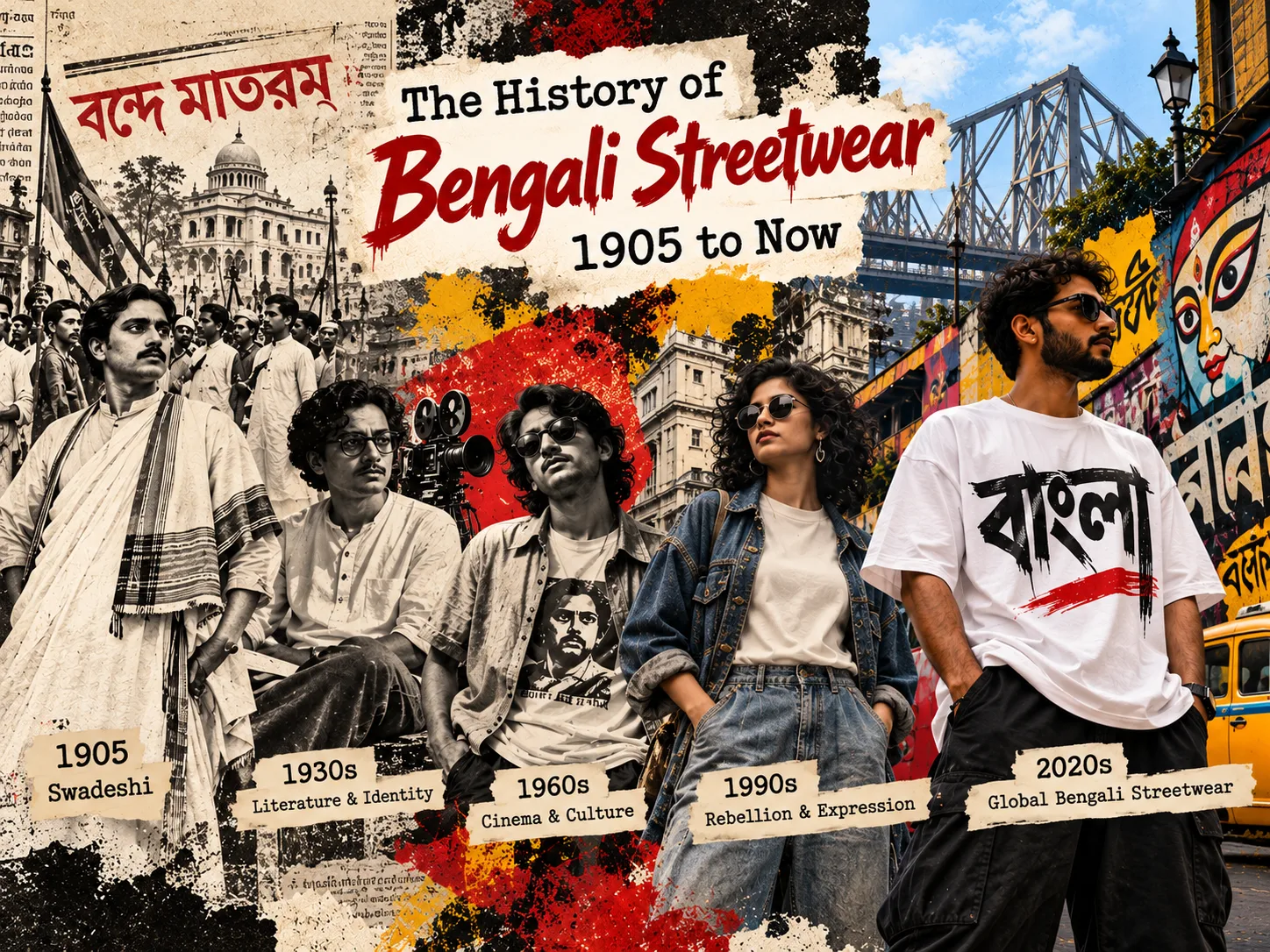
Long before “streetwear” was a category on a shopping app, Bengal was already using clothes to say things out loud. Every generation here has reached for fabric when words weren’t quite enough — to announce status, to defy an empire, to claim a language back. The oversized Bengali typography tee you see on the streets of Kolkata or Thane today isn’t a new idea. It’s the latest sentence in a conversation Bengal has been having with itself for over 150 years.
The Fabric That Traveled the World First
Start at the root, and Bengal’s fashion story is really a textile story. Dhakai Jamdani and the almost mythical Bengal muslin — fine enough, travelers wrote, to pass through a ring — made the region one of the world’s great weaving economies centuries before “Made in India” meant anything to anyone. The craft was significant enough that in 2013, UNESCO formally inscribed Jamdani weaving onto its Representative List of Intangible Cultural Heritage of Humanity — a global acknowledgment of a technique Bengali weavers had already perfected generations earlier, using a discontinuous weft method so intricate that patterns are built directly on the loom, never sketched out in advance. Rajshahi silk and hand-loomed tant cotton carried that same reputation. Bengal didn’t need to borrow craftsmanship from anywhere. If anything, the rest of the world came looking for it.
The Babu and the Blouse: Bengal's First Fashion Rebellions
By the 19th century, colonial Calcutta had produced a very specific character: the Babu. Wealthy, English-educated, and endlessly satirized in Kalighat paintings, the Babu wore a pleated dhoti with a Victorian waistcoat, carried a walking stick, and slipped his feet into leather shoes — a walking collision of two empires. It looked absurd to the folk painters mocking him, but it was also the first real evidence that Bengali dress could absorb outside influence without losing its own shape.
A more quietly radical shift was happening in women’s fashion at the same time, and it has a name attached to it: Jnanadanandini Devi, of the Tagore family of Jorasanko. In the 1860s, after reportedly being turned away from a British club for wearing her sari without an upper garment, she didn’t retreat — she redesigned. Blending a Parsi-style jacket with the traditional Bengali drape, she created what came to be known as the Brahmika sari, and taught the technique to other women through her own columns in Bamabodhini Patrika. It’s easy to read this as a footnote in sari history. It’s more accurately the first documented case of a Bengali woman turning a colonial insult into a fashion statement — and then teaching a generation of women to wear it with her. That same instinct, turning feminine power into personal reinvention, is the entire premise behind Adishakti a century and a half later.
The Great Poet Who Dressed on Purpose
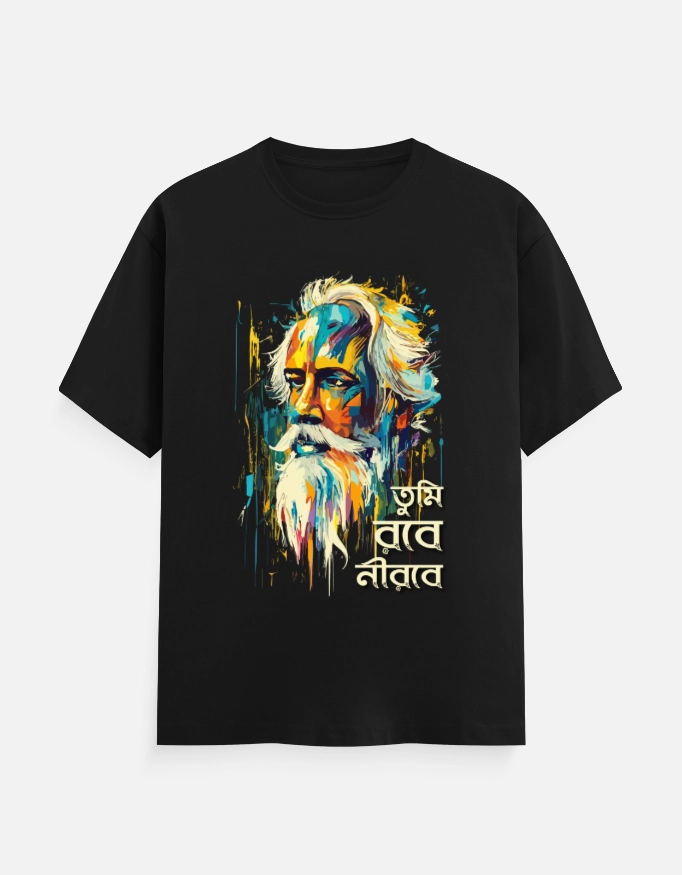
Jnanadanandini wasn’t the only Tagore rewriting the rules of Bengali dress. Her brother-in-law, Rabindranath Tagore, became arguably the most deliberate dresser in Indian intellectual history — favoring a long, loose outer robe known as the jobba, neither a kurta nor a Western coat, that gave him a silhouette entirely his own. It wasn’t vanity. It was a visual argument: that a Bengali intellectual didn’t need to choose between looking “traditional” or looking “modern.” At Santiniketan, the open-air university he founded, Tagore extended that philosophy into a whole aesthetic — women wore sarees draped in a distinctive, practical Shantiniketan style, and the institution actively promoted Kantha embroidery among local women, turning a domestic needlecraft into both an art form and an income. Tagore understood something brands spend decades trying to learn: that clothing, worn with intention, can carry an entire worldview.
When Wearing Khadi Was an Act of Defiance
If there’s one moment that defines Bengal’s relationship with clothing, it’s 1905. When the British partitioned Bengal, the response wasn’t just political speeches — it was a bonfire. Manchester cloth was publicly burned in Calcutta, and at a meeting at the Calcutta Town Hall on August 7, 1905, the Swadeshi Movement formally called for a boycott of British goods, khadi chief among them. Tagore himself backed the movement, tying it to symbolic acts like Raksha Bandhan as a gesture of unity across the newly divided province.
What makes this moment matter for a streetwear story specifically: for the first time, what a Bengali wore became a visible, unmistakable political statement. Buying foreign cloth was collaboration. Wearing khadi — spun on a charkha, a spinning wheel, in homes across the province — was resistance. Clothing stopped being just clothing — it became identity, worn in public, on purpose. That idea never really left Bengal. It just changed fabric, and occasionally, it changes register entirely — Nijer Chorkai Tel Din borrows the very same charkha for a smaller, funnier kind of self-determination: mind your own spinning wheel, and let everyone else worry about theirs.
Adda, Denim, and the Century In Between
The decades after independence softened the politics but kept the instinct. College Street’s book stalls and the Coffee House on the same road turned into the city’s great informal parliaments — where adda (that famously untranslatable Bengali institution of unhurried, opinionated conversation) happened over endless cups of tea, and where casual western wear — shirts, trousers, eventually jeans — slowly became everyday clothing rather than a foreign costume. If adda had an official uniform, it was whatever let you sit at a Coffee House table for four hours over one cup of cha without anyone minding. By the time India’s economy opened up in the 1990s, global denim and graphic-tee culture landed in Kolkata the same way it landed everywhere else in urban India: fast, and without much local flavor.
That’s really the gap Bengali streetwear had to fill. For a while, “casual wear” in Bengal meant the same jeans-and-plain-tee uniform as anywhere else in the country — comfortable, but silent. It said nothing about where you were from.
Durga Pujo: Where Clothing Becomes an Annual Ritual
No account of Bengali fashion is complete without the one week a year when the entire culture turns into a runway. From Mahalaya onward, Durga Pujo shopping isn’t a chore — it’s a countdown. New clothes for every day of the Pujo, often one outfit for Shashthi, another for Saptami, Ashtami demanding something sharper still, are practically a ritual obligation, and the markets of Kolkata — New Market, Gariahat, Hatibagan — turn into weeks-long festivals of their own well before the pandal-hopping even starts. It’s democratic in a way few fashion calendars are: everyone, regardless of income, budgets for at least one new outfit, because showing up to Pujo in last year’s clothes is its own small social statement. Food carries the same ritual weight — no Pujo adda is complete without someone arguing about where to get the best mutton biryani, which is exactly the spirit behind Mache Bhate Bangali, worn by people for whom fish and rice is less a meal than an identity.
The Return of the Mother Tongue
Somewhere around the last decade, that started to change — and not just in Bengal. Across India, regional-language typography has been quietly taking over graphic tees: Devanagari, Tamil, Gurmukhi, and Bengali script showing up boldly instead of being reserved for textbooks and signage. For Bengalis specifically, this has meant something extra, because the culture already had so much to draw from — a language that gave the world Tagore’s poetry, Satyajit Ray’s cinema, and Amartya Sen’s economics has no shortage of phrases worth putting on a chest.
That’s the real context for a t-shirt like Kotoi Rongo Dekhi Duniaye, which draws its name from Ray’s 1979 documentary work rather than being a generic “Bengali quote” tee. Ray’s cinema shows up more than once in Bengali streetwear, too — Onachar Koro Jodi Raja Tobe Charo Godi borrows its line straight from Hirak Rajar Deshe, proof that this generation isn’t just decorating fabric with the language, it’s quoting the actual cultural canon behind it. The same goes for something as simple as Ami Banglay Gaan Gai — “I sing in Bengali” — a t-shirt that’s really a direct descendant of the Swadeshi instinct: choosing your own language, on purpose, in public.
It travels, too. Ask anyone in the Bengali diaspora — in New Jersey, in London, in Dubai, in Toronto — what they miss most, and clothing rarely tops the list. But a t-shirt that lets a second-generation Probashi Bangali wear their grandmother’s language without having to explain it first? That’s a different kind of souvenir. It doesn’t need Durga Pujo or a wedding as an excuse. It just needs a Tuesday.
Where Bong Street Fits In
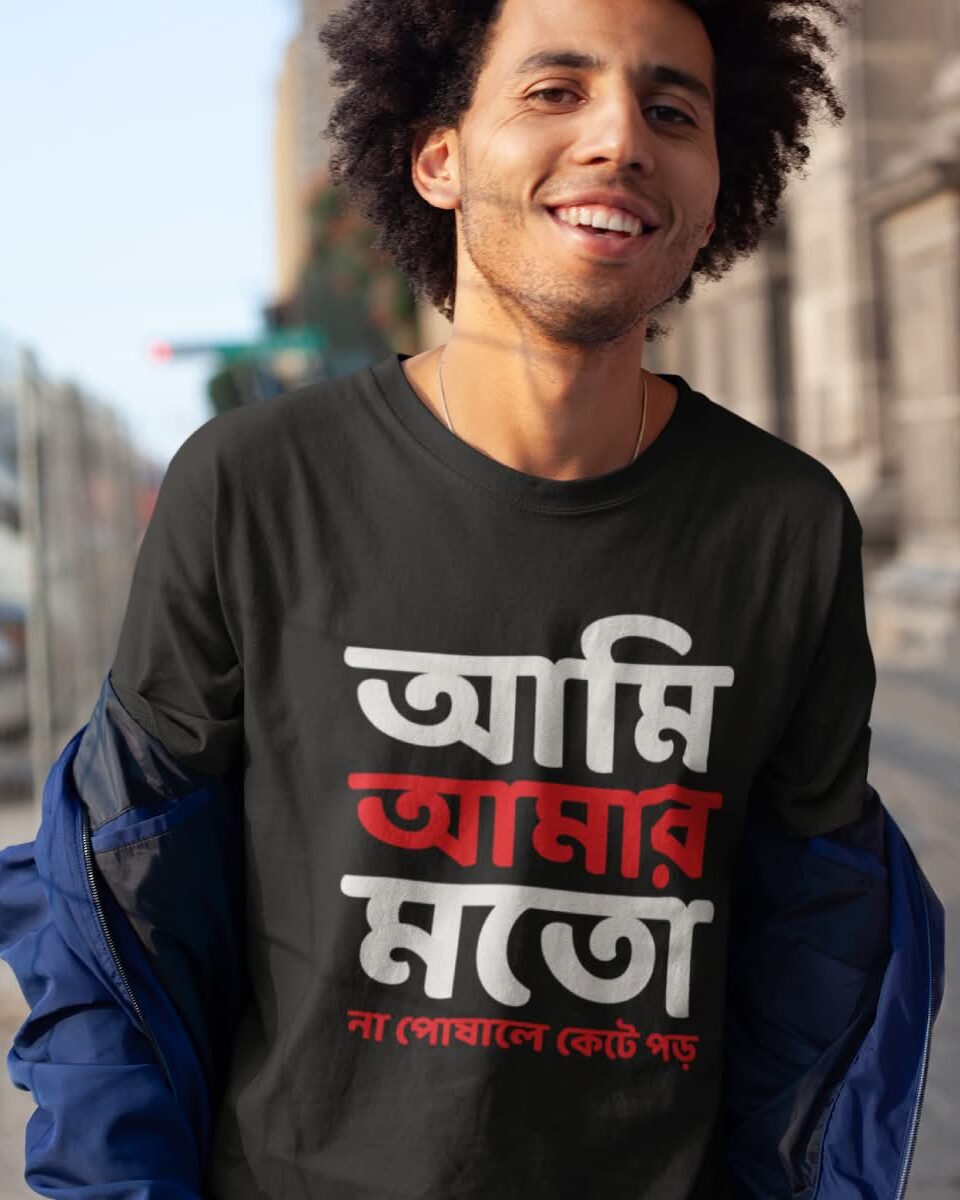
Which brings the story to now. The oversized Bengali t-shirts and unisex Bengali tees filling out streetwear racks today aren’t a break from this history — they’re its most comfortable chapter yet. Jnanadanandini Devi redesigned a garment to refuse an insult. Tagore built a whole visual philosophy out of one long robe. Swadeshi Bengal burned foreign cloth to make a political point. Today, that same refusal to shrink shows up in different registers — the quiet, unbending pride of Sirdara Ekhono Soja, or the sharper, unapologetic edge of Bishakto Manush — both printed in 240 GSM cotton instead of hand-spun khadi, but carrying the same DNA.
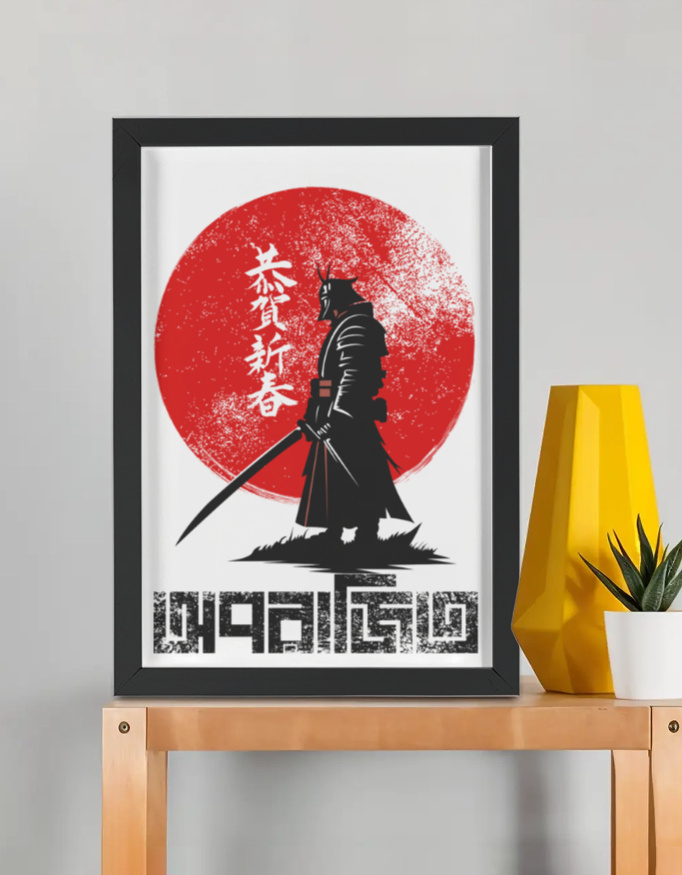
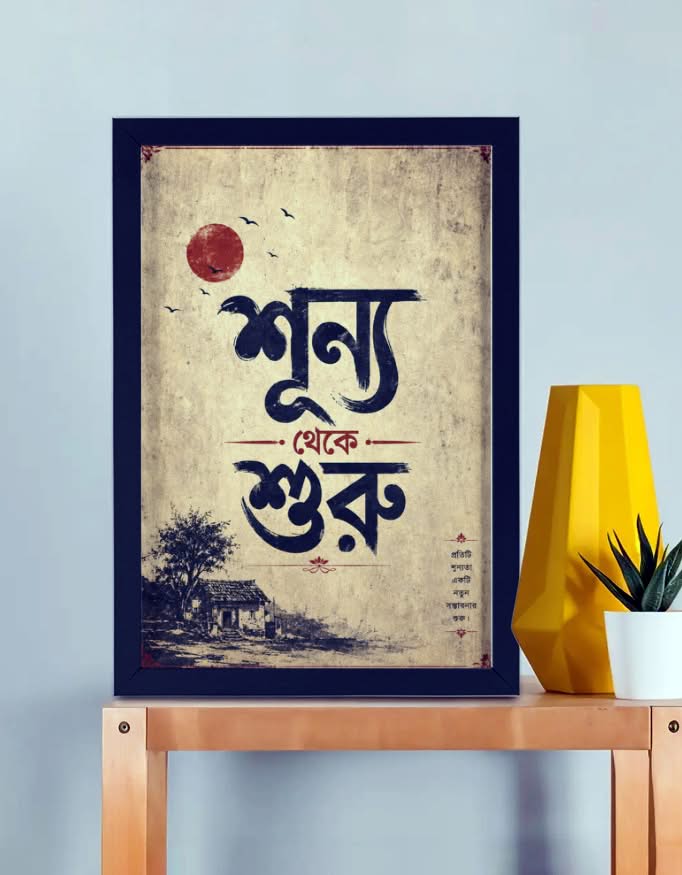
If clothing has always been how Bengal says the things that matter, an oversized tee with a language and a spine of its own is simply the modern way of saying them. For more of that same instinct in a different format, our framed Bengali wall art collection carries the language into spaces you don’t wear — but still want to be surrounded by.